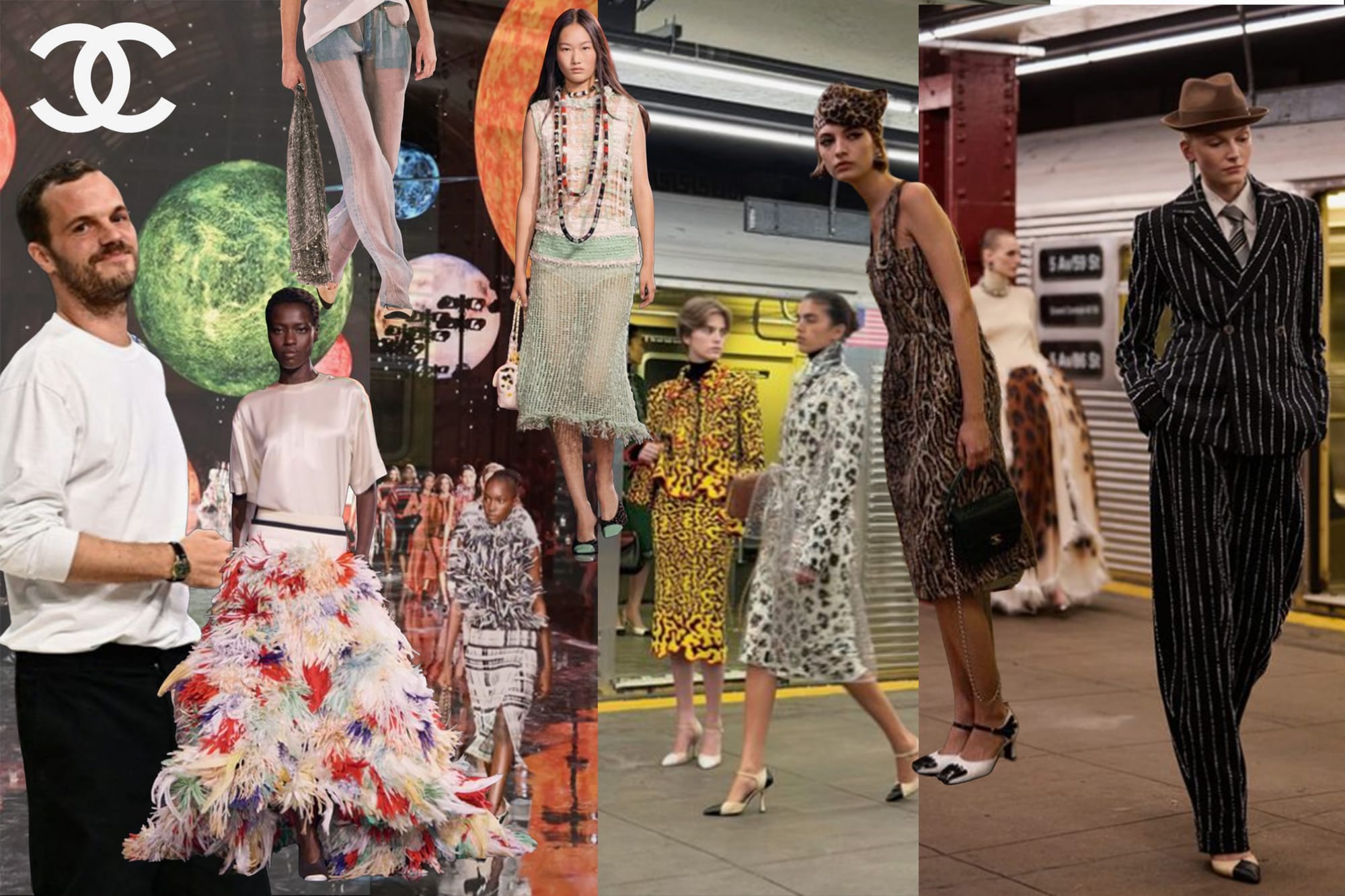
The line outside Chanel's Rue Cambon store on the morning of March 5 was the kind of line you usually see for a sneaker drop, not a Chanel jacket. The first pieces from Matthieu Blazy's debut collection had landed in stores that day, and editors, clients, and the generally curious had been queuing since dawn. By the end of the day, key items had sold out. The New York Times sent a reporter to the floor and got a quote comparing the scramble to the Hunger Games.
What had just happened was the most consequential luxury debut of the year, in a year already defined by debuts. Over the previous 18 months, more than a dozen of the world's largest fashion houses had changed creative directors. Blazy's arrival at Chanel was the culmination of that reset, and the early commercial response is now the most important data point the industry has about whether the bet it just placed will pay off.
Why Chanel chose Blazy
To understand why Chanel hired Blazy specifically, look at where he had just come from. From 2020 to 2024, he ran Bottega Veneta for Kering, and during that period, he grew the house's revenue by 6% year over year. That number sounds modest until you put it next to the rest of Kering's portfolio in the same period. Saint Laurent was in decline. Gucci was in full restructuring. The group as a whole was reporting double-digit drops in some quarters. Blazy was the only Kering creative director meaningfully growing his brand, and Chanel was hiring him at a time when the rest of the group was contracting.
The approach was specific. Blazy is a craft-led designer, which is industry shorthand for someone who builds collections around materials and construction rather than logos or visual identity. He came up through the studios of Raf Simons, Phoebe Philo, and Maison Margiela, all houses known for technical precision and intellectual rigor rather than for visible branding. His Bottega Veneta was logo-free, leather-forward, and built around the idea that the quality of the materials should be the thing the customer paid for. The Andiamo bag, which defined his tenure, carried no visible logo. The Intrecciato weave was the signal.
What Chanel was buying when it hired Blazy was a particular bet about where luxury is going. The bet, in short, is that the next generation of luxury buyers will pay for craft over branding, for restraint over spectacle, and for the kind of design that needs to be examined up close to be fully understood. Blazy's Bottega had been the most commercially successful version of that bet inside corporate luxury in recent memory. The Row, the independent American brand that had been operating on the same principles for nearly two decades, was the proof on a smaller scale that the bet worked at all. Chanel is a roughly $20 billion business with 30,000 employees. By hiring him, the house was applying that bet to one of the most heritage-laden brands in the world.
The debut, the subway, and the construction site
The first collection, Spring/Summer 2026, was shown in October 2025 under an illuminated solar system installed inside the Grand Palais. The set was already a statement. Blazy told the Business of Fashion he had a choice about how to approach the debut. "We can go two ways. Either we do a clean, modern, by the codes, by the book Chanel show, and it's a first step. Or we do this show as if it was our last. I took the last option." What he showed opened with a deconstructed tweed suit and closed with the audience on its feet. The references to Coco Chanel's own history were specific and earned. Shirts were made in collaboration with the historic French shirtmaker Charvet and given Chanel's signature chain at the hem, a nod to Gabrielle Chanel's practice of borrowing menswear staples from Boy Capel. The casting, the materials, and the soundtrack were all calibrated to signal that this was not a transitional show.
The second collection, Métiers d'art 2026, was shown in December on an abandoned New York City subway platform. Models wove through a stationary train and out onto the platform in oversized pinstripe suits, feathered gowns, and statement coats. The theme was a New York that felt half remembered and half invented: a 1970s journalist, a downtown actress, a Tribeca regular. Blazy framed it in his show notes as a love story between Chanel and New York.
The third collection, Fall/Winter 2026, was shown at the Grand Palais in March with brightly lacquered construction cranes framing the runway. The cranes were not a metaphor for incompletion. They were a statement that the house was being built, not unwrapped. Blazy quoted Coco Chanel in the show notes: "Fashion is a caterpillar and a butterfly. By day the caterpillar, by night the butterfly." Tweed was reworked with metallic yarns and silicone. Work shirts and blouses sat alongside reconstructed Chanel suits. The soundtrack opened with Lady Gaga's "Just Dance," which has not historically been a Chanel runway choice.
The through line across all three shows is a specific kind of dialogue with the Chanel archive. Blazy is not preserving the codes the way Virginie Viard, his immediate predecessor, did. He is also not disrupting them the way Karl Lagerfeld sometimes did. He is treating the heritage as raw material rather than as a constraint. The tweed becomes something it has not been. The suit becomes something it has not been. The Charvet shirts had a small metal chain sewn inside the hem, the same hidden detail Coco Chanel had built into her 1950s cardigan jackets to weight the hem and make the garment drape correctly. You cannot see the chain in a photograph. You can only feel it when you wear the shirt. That a Blazy debut would announce itself through a detail that nobody in the audience could see is characteristic of his entire design approach. What this approach asks of the buyer is a closer look. What it rewards, when the looking is done, is recognition of what is being quoted, what is being inverted, and what is being introduced for the first time. Blazy is not asking the reader to understand his clothes. He is asking the reader to read them.
The year of musical chairs
Blazy's arrival at Chanel did not happen in isolation. In the eighteen months before his debut, more than a dozen of the largest fashion houses in the world replaced their creative directors. The trade press tried out a few names for what was happening. The fashion mercato, borrowed from the European football transfer market. The Great Creative Reset of 2025. Neither phrase quite captured how compressed the disruption actually was.
The biggest moves were these, in approximate order of consequence. Jonathan Anderson left Loewe after eleven years to take the creative directorship at Dior, replacing Maria Grazia Chiuri on the womenswear side and Kim Jones on the menswear side. Demna left Balenciaga, after a decade defining the house's aesthetic of luxury irony, to take over Gucci, where Sabato De Sarno had been removed after two years of declining sales. Pierpaolo Piccioli, who had been the heart of Valentino for two decades before his departure in 2024, was named creative director at Balenciaga. Jack McCollough and Lazaro Hernandez left Proenza Schouler, the house they had founded, to take over Loewe in Anderson's place. Rachel Scott of Diotima was named creative director at Proenza Schouler. Donatella Versace, after 27 years at the brand that bears her family name, stepped down to become chief brand ambassador as the Prada Group prepared to acquire Versace for 1.5 billion euros. Louise Trotter left Carven to replace Blazy at Bottega Veneta. Some of these were resignations. Some were firings. All of them were a sign.
What was unusual about the reset was not that it happened but how compressed it was. Fashion has cycled through creative directors at a steady rhythm for as long as the contemporary luxury industry has existed. Houses replace creative directors when sales stall, when a creative vision exhausts itself, when the brand needs a refresh, or when the larger business wants the appearance of decisive action. What was different about 2024 and 2025 was that those forces converged across nearly every major European house simultaneously. Hermès did not change. Chanel and Bottega did, but on their own timetables. Almost everyone else moved in response to a deeper problem the industry had been collectively avoiding.
What the reset is really about
The deeper problem is that the luxury market is going through a structural reset, not a cyclical one. After the post-pandemic boom of 2021 and 2022, when revenge spending pushed luxury sales to all-time highs, the industry expected continued growth and built capacity accordingly. The growth did not continue. By 2024, the largest luxury groups were reporting flat or declining sales in their most important markets. Kering, the holding company that owns Gucci, Saint Laurent, Bottega Veneta, and Balenciaga, was particularly exposed. Gucci had generated roughly two-thirds of Kering's profit at its peak and was now in a multi-year sales decline. The rest of Kering's brands were doing better. None of them were doing well enough to offset Gucci's contraction.
The diagnosis the industry settled on was that the playbook had stopped working. The logo heavy, celebrity driven, scarcity by design model that had powered luxury growth through the 2010s was producing diminishing returns with younger buyers. Gen Z and the younger end of the millennial cohort, surveyed extensively in the industry's own strategy reports, were less loyal to any single brand. They were less responsive to overt logo branding. They were more interested in craftsmanship as a quality marker. They were more willing to mix high and low. They were also operating in a different macroeconomic environment than their predecessors. Real wages for younger workers had stagnated. Inflation had compressed discretionary income. The luxury price increases that had been routine throughout the pandemic had outpaced what buyers in their twenties and thirties could absorb. The result was an industry whose pricing was rising faster than its customer base could support, with no clear answer about how to grow the customer base back.
The creative director reset was the industry's response. Replacing a creative director is the most visible move a luxury house can make. It signals to the market that the brand is changing direction. It generates editorial coverage no advertising budget can buy. And it gives the house permission to reset prices, refresh its product lineup, and quietly cull the customer segments it no longer wants to serve. The cost of replacing a creative director can run into the hundreds of millions of dollars when contracts, severance, and the disruption to existing collections are factored in. The fact that so many houses made the move at the same time is a signal of how serious the underlying problem actually was.
Why Blazy's debut is the test case
Inside that wider reset, Blazy's debut at Chanel is doing something specific. Chanel is one of two or three brands in the world with the financial cushion to take a long view on creative direction. It is privately held by the Wertheimer family, which means it is not subject to the quarterly earnings pressure that shapes decisions at LVMH and Kering. Chanel can afford to give a creative director years to develop a vision instead of weeks to deliver a quarter. The bet the house made by hiring Blazy was that the answer to the wider luxury problem was not louder branding, not bigger spectacle, and not faster product turnover, but more careful craft, more attention to materials, and more confidence in the design itself to do the persuading.
The early commercial response suggests the bet is landing. Pieces from the Spring 2026 collection sold out within hours of arriving in stores. The industry data firm Sourcewhere reported a sustained surge of client interest in the weeks after the in-store launch, with demand accelerating once buyers could see the pieces in person rather than on the runway. The phenomenon was unusual enough that Vogue Business and the New York Times both wrote separate features trying to characterize it. The Times got the Hunger Games quote on the floor at Rue Cambon. Anyone who has lived through a fashion month or two will tell you that even the most anticipated debuts rarely produce queues that need crowd control.
A single quarter of sellouts does not prove that craft-led design will pull luxury out of its slump. The honest read is that Blazy's debut has bought Chanel enormous goodwill and validated the broader bet. The harder tests are still ahead: whether the commercial momentum sustains through the next four to six collections, whether the price increases that will inevitably follow will be absorbed by buyers, and whether the rest of the industry can replicate something Blazy is doing with the benefit of an unusually patient owner who does not answer to public shareholders, and an unusually deep design archive built over more than a century.
What 2026 will reveal
What 2026 will reveal is whether the rest of the industry can deliver the equivalent of what Blazy has delivered at Chanel. Demna's first collections at Gucci will show whether a more conceptual designer can give Kering's most important brand a coherent identity again. Anderson's first collections at Dior will show whether the LVMH scale machine can accommodate a designer who built his Loewe career on small, careful gestures rather than on scale. McCollough and Hernandez's Loewe will show whether two designers who built one brand together can build another. Each of these is a different version of the same question Chanel was asking when it hired Blazy. What does this house mean to a buyer who does not respond to the things it has historically meant?
The Blazy debut is the only one that has produced a clear answer so far. The rest of the industry is watching what he does next.